Unit 4, Monkton Park, Farnham
Why the asset caught my eye
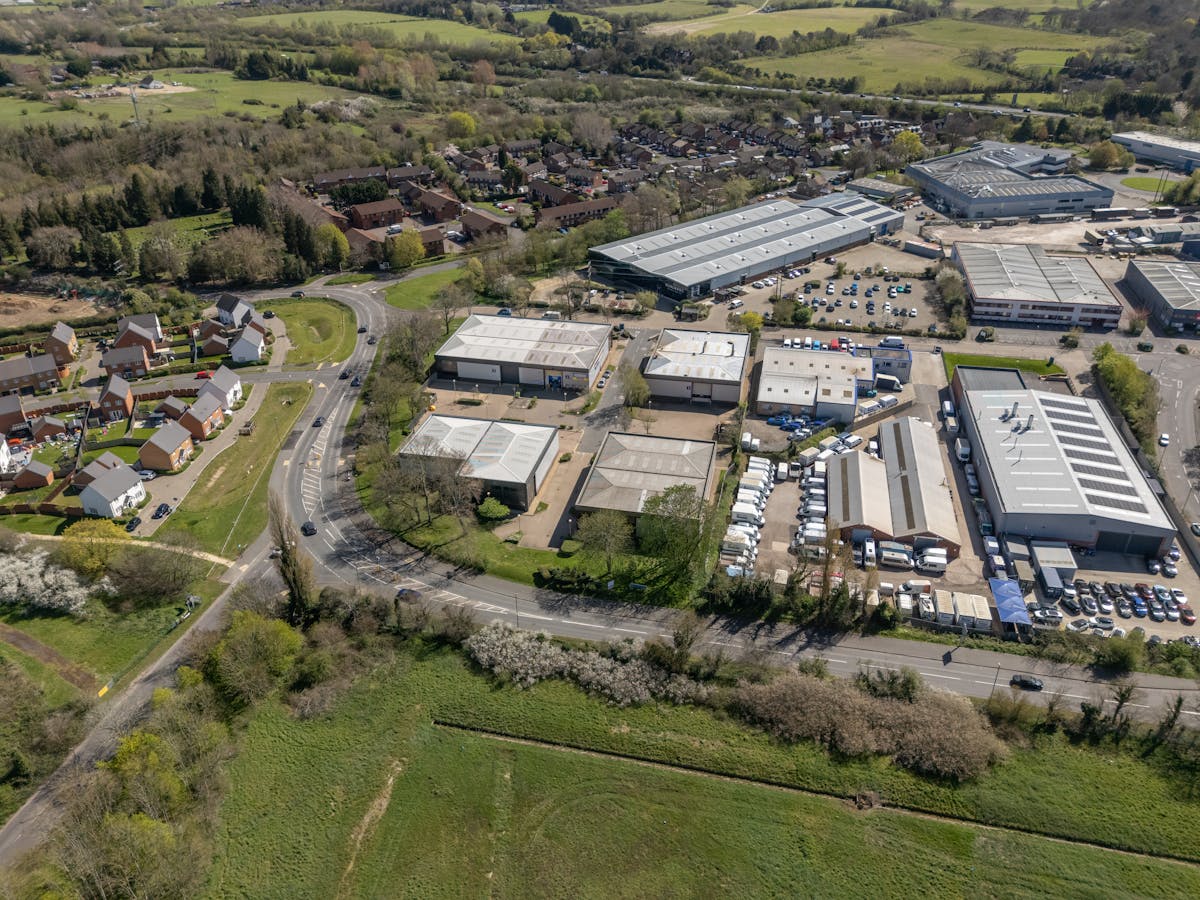
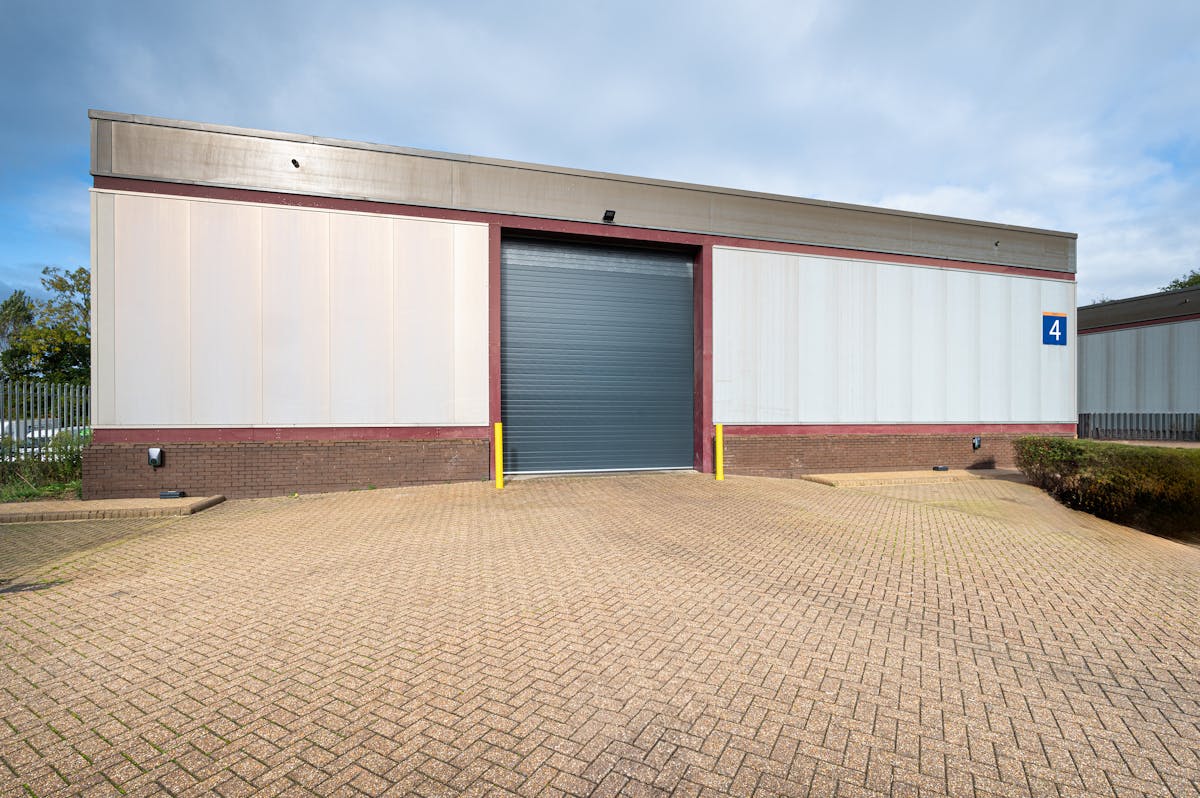
As I start to build a portfolio of real estate financial models, I thought I would begin by modelling a property that I have driven past on my way to and from the gym for the last two years. For the majority of this period, these three small industrial/warehouse units in Monkton Park, Farnham have been sitting with a vacant car park, overgrown shrubbery and a clear lack of tenants.
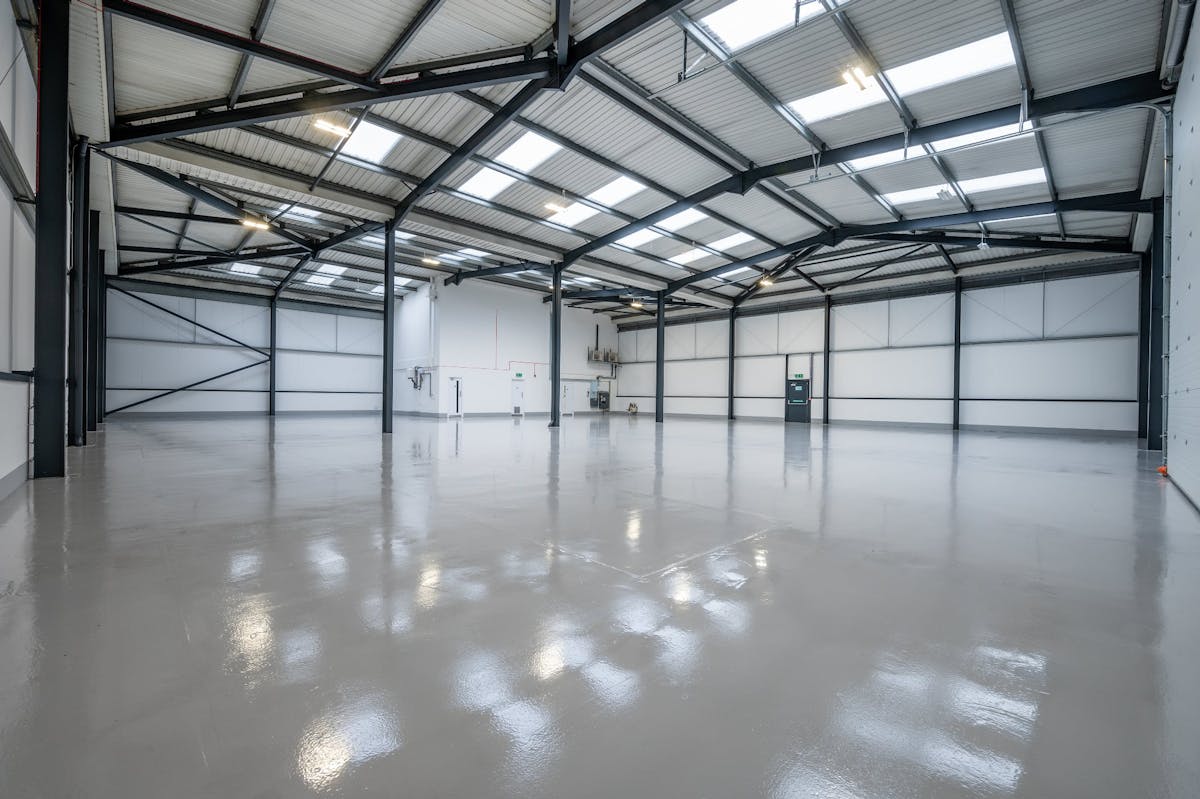
A few months ago, I noticed that these properties had been refurbished, and I saw that they were being marketed by Curchod and Knight Frank. So, for my first portfolio entry, I decided that underwriting a single unit acquisition from these three properties was a manageable enough task to put the skills I had learnt through the A.CRE Financial Modelling Accelerator into practice.
Establishing an ERV
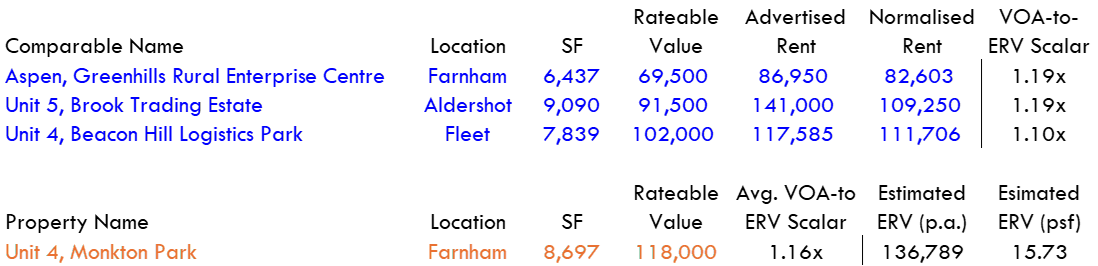
Without access to institutional platforms, I derived the ERV from publicly available sources and some creative thinking. The solution I ended up using was a VOA-scaling ERV methodology. This included:
- Capturing the April 2026 rateable values from the Valuation Office Agency, which represents the government's assessment of what market rent was in April 2024.
- Adjusting for property-specific characteristics across comparables, such as yard space.
- Applying a 5% leasing negotiation haircut to the advertised rent of the selected comparables to land on a normalised rent.
- Dividing the comparable property's contract rent by its respective rateable value to give a VOA-to-ERV scalar.
- Averaging the VOA-to-ERV scalar across the comparables.
- Applying the averaged scalar (1.16x) to Unit 4's rateable value of £118,000 to arrive at an estimated ERV of £136,789, or approximately £15.73 psf.
I rounded the estimated ERV up to £15.75 psf (£136,978 p.a.) for the model on the basis that a leasing agent is unlikely to market a unit at £15.73 psf in practice. This averaged scalar aims to capture any rental growth between April 2024 and the analysis start date (August 1st, 2026) and any difference between the VOA-assessed rental values and what leasing agents are actually advertising them for.
I assumed a market rental growth of 3.00% per year across the hold period, which is in line with Knight Frank's 2026 outlook for UK industrial/warehouse rental growth. This growth feeds into the model at the mid-lease rent review.
Acquisition mechanics
Yield assumptions
The entry net initial yield (NIY) of 6.50% in the model is based on the June 2026 Knight Frank Prime Yield for industrial/warehouse units in the South East of England, or 5.25%. As I understand it, the reported prime yield represents the NIY of fully let, institutional-grade logistics assets with strong tenant covenants and long unexpired terms. Unit 4 in Monkton Park departs from that definition on several axes, so I made the following upward adjustments to the NIY from the prime yield:
- Despite the unit being close to the centre of town and benefitting from easy access to the A31, which allows for access to the M3 and A3 within 15 minutes, Farnham itself is still a quaint market town (+50bps).
- Upon acquisition, the property will be vacant (+50bps).
- Although the building was recently renovated, it was still built in the late 1980s which increases the risk of higher maintenance and repair bills in the future (+25bps).
This implies 1.25% spread from the prime yield, leading to the final entry NIY in the model of 6.50%. When calculating my exit yield assumption, I took into account that the building would be another 7-years into its economic lifecycle, and the fact that there will only be 3-years remaining on the current lease. This carries risk and potential future income volatility for the prospective buyer at the end of our hold period. Based on this, I applied a 50bps spread above the entry NIY to give an exit yield of 7.00%.
Lease and debt assumptions
Given the unit's specification, location and recent renovation, I assumed that the property would be able to find a suitable tenant within 6 months post-acquisition on a full repairing and insuring (FRI) lease. To incentivise a tenant to sign a long-term lease, I also modelled a 6-month rent-free period, giving a total of 12 months where there would be no rental income. To handle this income gap, I included a 12-month interest holiday period to ensure the DSCR did not turn negative in the first year.
For the loan itself, I assumed a term that matched the hold period (7 years), a 50% LTV and a 7.00% all-in interest rate. I modelled a conservative LTV because the property had been fully renovated prior to my proposed purchase, therefore we would be purchasing it at a peak post-renovation price and the seller would have already taken the value upside from the renovation. Purchasing at this premium means the entry rental yield is tighter, so by keeping the loan at 50%, the property should easily be able to cover the debt payments, which is evidenced by the average DSCR of 2.08x.
The 7.00% all-in rate approximately represents 6-month SONIA (~3.75% as of early August 2026) plus a margin of ~3.25%. Of course, the exact loan margins will be hidden behind an industry paywall, so I priced this on the higher side to reflect the fact that the unit is vacant upon acquisition, is under 10,000 sq ft and therefore harder for a lender to recover against in the event of default, and sits in a regional market town rather than as part of a larger institutional logistics hub.
Returns
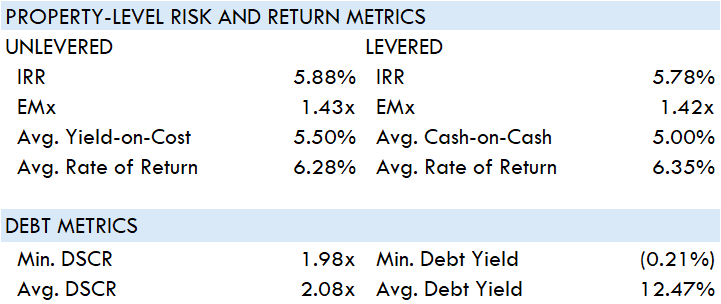
The investment opportunity at Monkton Park, Farnham renders an unlevered IRR of 5.88%, which is 10bps higher than the levered IRR of 5.78%. At this level, leverage is not accretive to the deal as the modelled all-in interest rate of 7.00% sits above the entry NIY, and therefore the property would achieve, albeit marginally, higher returns as part of a cash-only deal. The model also returns an unlevered equity multiple of 1.43x, meaning for every £1 of the ~£1.1m equity deployed we would receive £1.43 over the 7-year hold period. Given that this property, although recently renovated, is nearing 40 years old, is vacant at purchase and is a single-let unit in a secondary market town, I do not believe that this equity multiple represents an acceptable return considering the risk-profile.
The average cash-on-cash return, or the annual cash return on the equity invested, of 5.00% reinforces this. Over the hold-period, this deal would earn roughly the same annual return as a high-yielding savings account, and you could achieve that return without being tied to the illiquidity of a real estate investment.
After considering the return metrics, I do not think that this deal works at the post-renovation pricing of ~£2.05m. It is likely that the value in this asset would have needed to have been captured before or during the refurbishment works, as this would have allowed us to enter the deal at a higher entry NIY. This makes sense, as in reality, it is unlikely that the pre-renovation purchaser would be looking to sell the property upon completion of the refurbishment works. This was a modelling exercise based on a property I drive past going to the gym, after all.
Where this deal works
As mentioned before, the value in this deal was captured by whoever bought the property when it was still the run-down unit I used to drive past. I solved for a 15% levered IRR to see where the pre-renovation acquisition price would need to sit for this deal to work.
At this return level, the total acquisition cost would need to be ~£1.49m, which represents a ~£550k reduction on the total acquisition cost in my model. At this price, the entry NIY widens to ~8.90%, meaning that the roughly 240bps of yield compression is captured by the hypothetical seller that undertook the risk of renovation. Furthermore, at this entry NIY debt becomes accretive to the deal rather than dilutive as the 8.90% yield now sits comfortably above the 7.00% cost of debt.
This is where the return on this asset was generated, and by arriving after it had already completed, there was no value left to capture.
What I'd do differently next time
Upon completion of this model, I realised that I was not capturing the fact that the rent would be reviewed halfway through year 6 due to the 6-month void period at the beginning of the hold period. Because of this, the model captures a whole year of rent at the reviewed level. Although this doesn't materially impact the model due to the conclusion I came to about how the value would have needed to have been captured pre-renovation, it is not best practice.
Going forwards, it would be beneficial for scenarios like this to have a monthly model rather than an annual one. Beyond the move to monthly, I would also split the ERV between the ground-floor warehouse and first-floor office space rather than applying a blended rate across the whole GIA, as these are different use types that command different rents. Finally, I would include a capex reserve even under an FRI lease, as there are structural and lifecycle costs such as roof, cladding, drainage repairs and maintenance that typically sit with the landlord and are not covered by the tenant's repairing obligation.