Ebb & Flow, Reading

Introduction
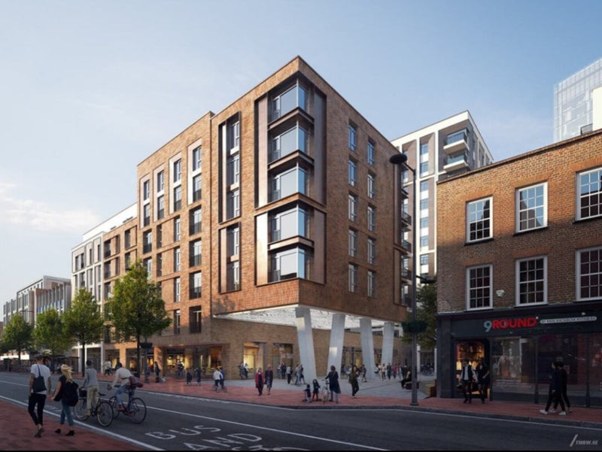
The area immediately next to the main entrance of Reading station, known as Station Hill, has undergone a c.£850m mixed-use redevelopment scheme over the past few years. As someone that used Reading station as a changeover point on my way back to Exeter whilst I was at university, I was able to see the area transform over time. Whilst thinking about what my next portfolio entry could be, I came across the 2026 ARGUS University Challenge competition[1], and saw that the Station Hill redevelopment project was the case study in question. These two factors meant it felt like the natural project to take forward as my next underwrite.
Whilst the case study within the competition encompassed the entire redevelopment project, I wanted to focus on Ebb & Flow, a 598-unit build-to-rent (BTR) property at the heart of the project. I chose this specifically because it felt like a meaningful step-up in scale when compared to the Monkton Park underwrite I did for my first portfolio entry, and also because I wanted to explore modelling a multifamily property. This feels like the most tangible form of commercial real estate to me, as after all, it is where people live.
Through my early research into the asset, I could see that PIC (Pension Insurance Corporation) had acquired Ebb & Flow from the original developers in March 2026[2]. PIC is a pension-risk transfer (or bulk annuity) insurer, which means that they take on defined benefit pension liabilities from companies in exchange for a lump-sum and assume the obligation to pay the companies' pensioners over the following decades. The defined benefit pensions that they are now obligated to pay on behalf of the company typically grow in line with inflation. Therefore, there is a need for PIC to invest in assets that produce stable cash flows that grow with inflation too, to ensure that their liabilities do not outpace their assets.
Based on this, I have modelled the acquisition from PIC's perspective. This means a longer hold period of 10 years and an acquisition done on an unlevered basis, as PIC would finance the acquisition through the lump-sums they receive by taking on companies' pension obligations.
Asset context and entry yield pricing
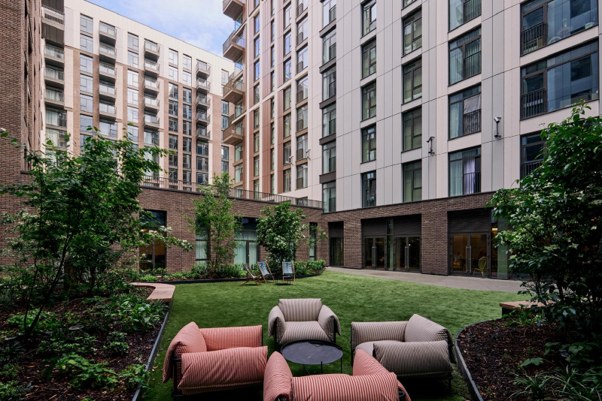
The 598 units are split between the Ebb building (415 units) and the Flow building (183 units). The asset is positioned as a premium lifestyle BTR property with design-led, modern apartments and an amenity-rich offering with features like a 24/7 gym with free exercise classes, co-working space, resident lounge and 24-hour support team.
On top of the product itself, the location makes this asset stand out. Ebb & Flow sits a two-minute walk from Reading station, which gives tenants direct access to the Elizabeth Line and frequent trains to London Paddington in under 25 minutes. This effectively pulls those who work in central London into the tenant catchment, without them having to pay London rents.
Reading itself is a serious employment hub in its own right. As per Centre for Cities, it ranks 4th in the UK for the number of active businesses per 10,000 people, and has the 3rd highest average weekly workplace earnings[3]. Ebb & Flow is well positioned to capitalise on this reputation, with the main employment areas near the property being:
- One Station Hill, the grade-A office next door within the same redevelopment, is anchored by international corporations like PwC and PepsiCo.
- Green Park Industrial Estate, a tech and life-sciences hub home to Virgin Media O2, Three and Bayer, is only a ~7 minute train ride away.
- Thames Valley Park, with Oracle and Microsoft offices, is a 10-15 minute drive away.
- Shinfield Studios, a major film and television production complex.
Taken together, this is a premium product with top-class amenities, sitting on top of a transport node that allows tenants to access both high-wage local employment and jobs in central London. This combination puts Ebb & Flow above where I would price a standard institutional-quality BTR in the South East.
The Knight Frank Prime Yield in July 2026 for institutional-quality BTR in the South East was 4.50%, with the Zone 2 and Zone 3-4 London primes sitting at 4.15%-4.30% and 4.30%-4.50% respectively[4]. Based on the factors above, I have modelled the entry yield for Ebb & Flow at 4.25%, which is in the combined Zone 2-4 London range. This aims to capture the combination of high local wages, business density, and direct commuting access to central London.
Underwriting assumptions
Unit mix and rental income assumptions

Whilst there was no publicly available information regarding the unit mix of Ebb & Flow, I was able to find information about the unit mix of the upcoming Phase 3A of the Station Hill redevelopment, built by the same developer as Ebb & Flow, Lincoln MGT. Of the 600 units in Phase 3A, there are expected to be 34 studios, 330 1-beds, 214 2-beds and 22 3-beds[5]. I assumed the same unit mix for Ebb & Flow, with a small two-unit deduction to the number of 1-beds to reach the 598 units across the two buildings.
There were limited live listings when I began to build my financial model, which I suppose is a great signal regarding the health of Ebb & Flow as an income-producing asset, but not terribly helpful to me as someone trying to create assumptions. The two listings were both for 1-beds, at £1,825pcm and £1,890pcm. I attribute the difference to things like whether or not the unit has a balcony and what floor it is on. The average of these two listings gave me a market rent assumption for the 1-bed units of £1,857.50pcm.
I then calculated a scalar for the 1-beds based on the market rent divided by the listed starting rent on Ebb & Flow's website, which came out at 1.09x. I applied a scalar to each of the other unit types on the same basis, with the caveat that I decreased the scalar as the number of bedrooms in the unit increased. I believe there is likely to be lower demand for 3-bed units in premium BTR properties when compared to 1-bed units, primarily because these types of properties are typically taken up by commuters. Additionally, you are also more likely to be competing with standard housing when there are more bedrooms in a unit. The decreased scalar of 1.05x for the 3-beds also brings it in line with the one historical listing I did see of a 3-bed in Ebb & Flow, at £2,900pcm.
I modelled two separate rental growth rates, with the short-term growth rate of 3.75% being a blend of Knight Frank's estimated 4% multifamily rental growth rate in 2026 and 3.5% in 2027[6]. I then modelled a long-term growth rate of 3%, which aims to capture target CPI + 1%.
My general vacancy and loss-to-lease assumptions are derived from Grainger plc's HY'26 report, with Grainger being the UK's largest listed provider of private rental homes. They reported 96% occupancy across their portfolio, and a 2% rental uplift on new lets[7]. The latter figure gave rise to my loss-to-lease assumption, as loss-to-lease is the difference between in-place rents and market rents. Given that these figures are an average across their large multifamily/BTR portfolio, I thought it was safe to assume the same figures for Ebb & Flow.
Operating expense assumptions
My operating expense assumptions come from the same HY'26 report as my general vacancy and loss-to-lease assumptions. Grainger plc reported property operating expenses that were 25.98% and 27.11% of gross rental income as of March 31st, 2026 and March 31st, 2025 respectively. Using those figures as a benchmark, I chose to model operating expenses for Ebb & Flow at 25% of total rental revenue. This is largely in line with Knight Frank's 2026 Multifamily Outlook report too, where on average, operating expenses took up 24% of total cashflow.
Within the 25% assumption, I weighted staffing costs, repairs and maintenance, and communal utilities as the largest line items to try to capture the amenity-heavy nature of Ebb & Flow's operations.

I modelled business rates outside of the operating expense assumption, as I was able to find the rateable values of the commercial elements of the property through the Valuation Office Agency's website. Only the ground-floor coffee shop and showflat complex are rateable, giving a total business rates charge of £36,768 p.a.
I tapered the operating expense growth rate down across the hold period, starting at 3.50% in years 2-3, before moving to 3% in years 4-5, and stabilising at 2.50% from year 6 onwards. The higher near-term rate tries to reflect where inflation is currently sitting, whilst the longer-term rate converges towards the target inflation rate.
Finally, I modelled a capital expenditure reserve of 2% of total rental revenue, which works out to approximately £480 per unit in year 1 and rises to £638 per unit by year 10. This reflects the need to maintain the premium finish and top-tier communal infrastructure to protect the pricing premium at exit.
Returns analysis
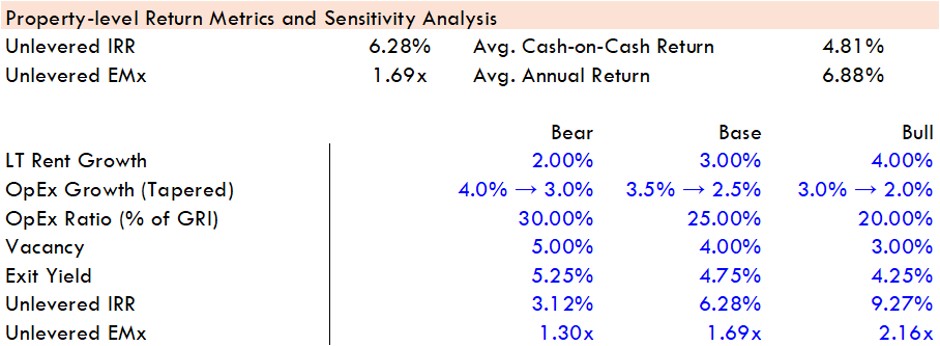
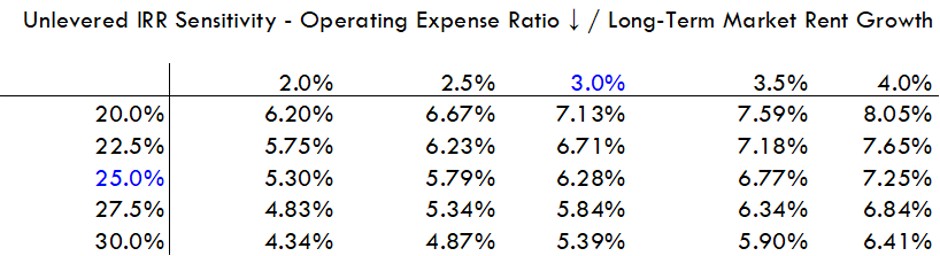
When calculating the reversion value, I modelled a 50 basis point expansion from the entry yield to account for the fact that the asset would be a further 10 years into its economic lifecycle. This resulted in a net proceeds from reversion of ~£293m, or a net profit of ~£167m across the hold period.
The opportunity to purchase Ebb & Flow yields an unlevered IRR of 6.28% and an equity multiple of 1.69x. For a leveraged buyer, these numbers would not clear, as the unlevered return would likely sit below any all-in cost of debt with the base rate at 3.75% as of the time of writing. This would mean leverage would be dilutive to the acquisition, which, along with the scale of the acquisition (~£226m purchase price), is precisely why Ebb & Flow ended up being purchased by an unlevered institutional buyer.
For PIC, the more important metric is perhaps the average cash-on-cash return of 4.81%. PIC's fundamental need is not necessarily the total return number, but the stream of income that the asset generates. As a pension-risk transfer provider, they need to hold assets that generate income on a schedule that matches their outflows to companies' pensioners. The 4.81% average cash-on-cash return, rising from 4.13% in year 1 to 5.51% in year 10, is a convincing sign that this investment opportunity generates income on the growing and predictable basis that PIC needs to meet their pension obligations.
The rumoured purchase price that PIC paid for Ebb & Flow back in March 2026 was in the region of £200m-£210m, which is approximately 7%-11.75% lower than the purchase price of ~£226m that I landed upon. This could be attributed to many things, such as an implied entry yield closer to 4.60%-4.80%, which would suggest that PIC did not price Ebb & Flow as aggressively as I did, instead opting to use a more conservative entry yield closer to the KF July 2026 Prime Yield for the South East. It may also mean that PIC's own assumptions on rent growth, operating expenses or vacancies were more conservative than mine.
All in all, I am quite proud of this underwrite, and only being 7%-11.75% off of the reported purchase price without access to all of the information that a modeller at PIC would have had is encouraging.
References
- ARGUS University Challenge 2026 Case Study
- PIC — press release on Reading BTR acquisition (March 2026)
- Centre for Cities — Reading city profile (2026)
- Knight Frank — UK Living Sectors Prime Yield Guide, July 2026
- BBC News — Station Hill Phase 3A unit mix
- Knight Frank — 2026 Multifamily Outlook
- Grainger plc — HY26 Results Announcement